












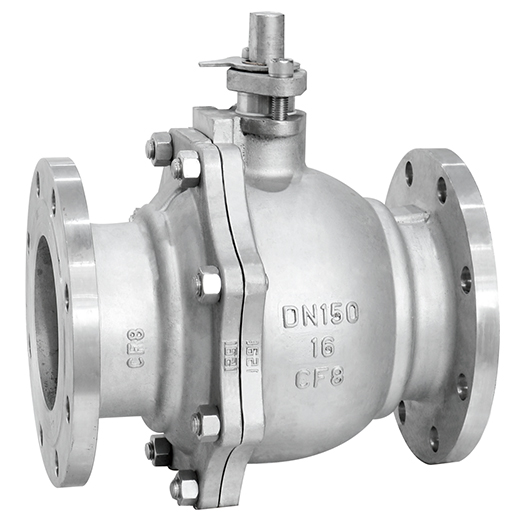
National Standard Floating Ball Valve
Product overview:
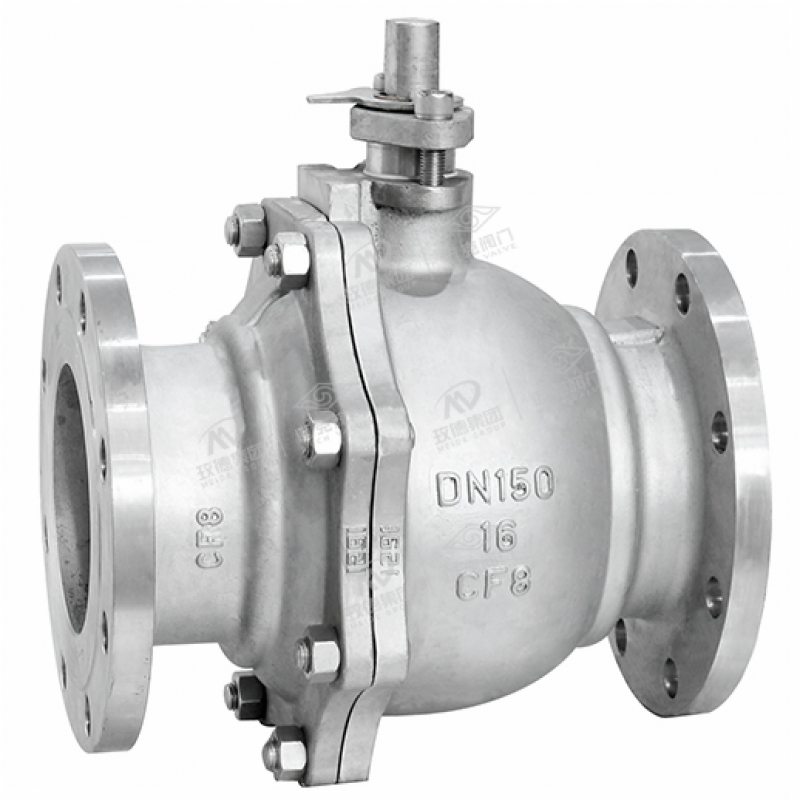
The ball valve is a valve device widely used in the field of fluid control. Its core component is a sphere with a through hole. By rotating the sphere 90 degrees, the through hole can be aligned with or perpendicular to the pipe, thereby enabling fluid on and off and flow adjustment. The main advantages of ball valves include simple structure, excellent sealing performance, light operation and low flow resistance, making them an indispensable key equipment in the oil, natural gas, chemical and water treatment industries. According to the structural design, ball valves can be divided into floating ball valves and fixed ball valves: floating ball valves rely on medium pressure to achieve sealing and are suitable for medium and low pressure scenarios; fixed ball valves mechanically fix the ball and are suitable for high-pressure or large-diameter pipelines. In addition, according to the connection method, ball valves can also be divided into flange type, thread type and welding type to meet different installation needs. Ball valves are particularly suitable for working conditions with high pressure, high temperature and corrosive media, especially in situations where quick opening and closing or frequent operations are required. With the advancement of material science and manufacturing technology, modern ball valves have continuously improved in terms of corrosion resistance, sealing performance and intelligence, enabling ball valves to meet more stringent industrial needs while improving system reliability and efficiency.
Product parameters:
Size range: 1/2”~48” (DN15~DN1200)
Pressure rating: ASME 150~2500LB (PN16-PN420)
Temperature range: -46°C to 538°C
Connection methods: flange, welding, threaded, etc.
Main materials: carbon steel, stainless steel, duplex steel, alloy steel, etc.
Sealing surface hardening treatment methods: Stellite alloy and nickel-based alloy overlay welding, WC spraying.
Operating methods: manual, electric, pneumatic, hydraulic, pneumatic-hydraulic, electro-hydraulic, etc.
Product standards:
Design standard: GB12237
Structural length: GB12221
Connection flange: HG/T20592
Testing and inspection: GB/T26480
Features:
1. This ball valve is suitable for cutting off or connecting pipeline media on pipelines with nominal pressures of 1.6-42.0MPa (Class150~2500) and operating temperatures ≤538°C in various working conditions such as petroleum and chemical industries.
2. It has the lowest flow resistance, enabling rapid opening and closing. The valve operates without impact during rapid opening and closing. It features a fireproof, anti-static, and anti-explosion safety structure. The ball and seat maintain a tight seal when fully open and fully closed.
The ball valve is isolated from the medium, so the medium passing through the valve at high speed will not cause erosion of the sealing surface. The ball valve passage is flat and smooth, and it is not easy for the medium to accumulate, so it can be used for pipeline ball passage.
3. Depending on the medium and pressure, the sealing surface can be selected as soft seal or hard seal, and the structure can be selected as floating ball, fixed ball, tee, cross, V ball, eccentric hemisphere, etc.
4. The ball and seat sealing surfaces of the ball valve are made of hard alloy material, which is corrosion-resistant, wear-resistant, high temperature and high pressure resistant, and has a long service life.
5. Ball valves only require a 90° rotation to open and close, making them easy to automate and control remotely. They can be equipped with...Configure various driving methods.
Related Products
Submitted successfully
We will contact you as soon as possible


