













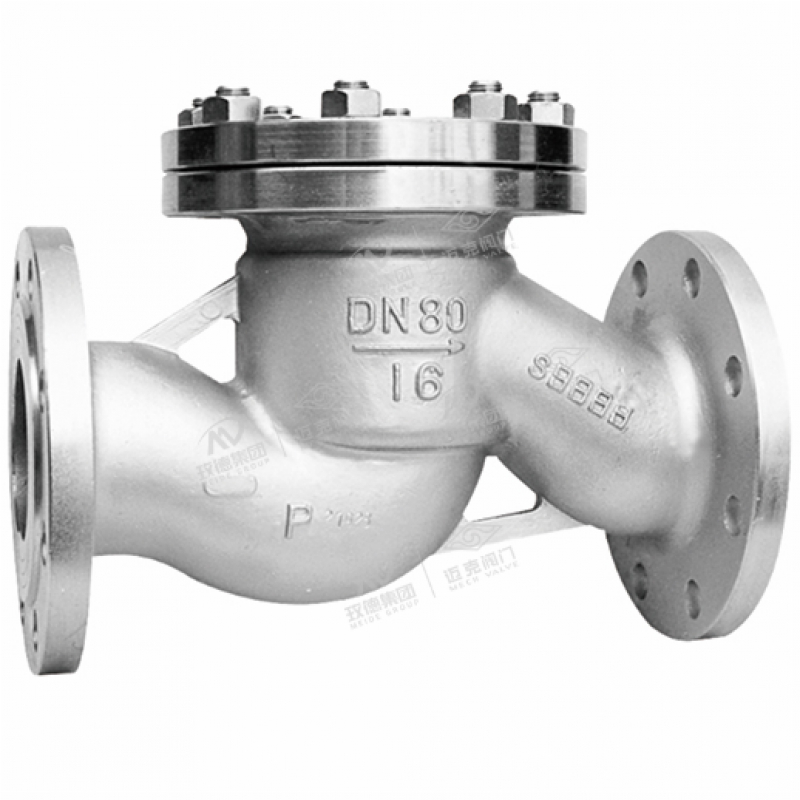
National Standard Lift Check Valve
Product overview:
A check valve is an automatic valve primarily used to prevent backflow of media and ensure unidirectional fluid flow. Its working principle relies on the pressure of the medium itself to open the valve disc. When the medium flows in the opposite direction, the valve disc automatically closes under the force of the weight of the valve cover or the action of a spring, preventing backflow. Check valves are widely used in water treatment, petrochemicals, power generation, HVAC, and other fields. Common types include swing, lift, butterfly, and ball valves. They are simple in structure, reliable in operation, and effectively protect pipelines and equipment from backflow damage. When selecting a check valve, the characteristics of the medium, pressure rating, installation direction, and operating environment must be considered to ensure its efficient and stable operation.
Product parameters:
Size range: 1/2"~24" (DN15~DN600)
> Pressure grade: ASME 150~2500LB(PN16~PN420) >Temperature range: -46°℃ -600℃
Connection methods: flange, welding, threaded, etc.
Main materials: carbon steel, stainless steel, duplex steel, alloy steel, etc.
Sealing surface hardening treatment method: Stellite alloy and nickel-based alloy overlay welding
Product standards:
Design standard: GB/T 12235
Structural length: GB/T 12221
Connection flange: GB/T 9124
Testing and inspection: GB/T 26480
Features :
1. Check valves are suitable for pipelines in various working conditions such as petroleum, chemical, and thermal power plants with nominal pressure of 16-42.0 MPa (Class 150~2500) and working temperature ≤600℃. Their function is to prevent backflow of the medium in the pipeline.
2. Check valves can be classified into lift check valves, swing check valves, and butterfly check valves according to their structure. Lift check valves have a valve disc that moves up and down along a line in the channel, offering reliable operation, but with higher fluid resistance, making them suitable for small-diameter applications. Swing check valves have a valve disc that rotates around a pivot. Their fluid resistance is generally lower than that of lift check valves, making them suitable for larger-diameter applications. Butterfly check valves have a simple structure, lower flow resistance, and lower water hammer pressure.
3. The sealing surface is overlaid with Co-based hard alloy, which has good wear resistance, corrosion resistance, scratch resistance and long service life.
4. Nominal pressure ≥15.0MPa (Class 900) The middle cavity adopts a self-tightening sealing structure, and the sealing performance is enhanced as the pressure increases, thus ensuring the sealing performance.
5. The materials of the parts and the dimensions of the flanges and weld ends can be reasonably selected according to the actual working conditions or user requirements to meet various engineering needs.
Related Products
Submitted successfully
We will contact you as soon as possible


